
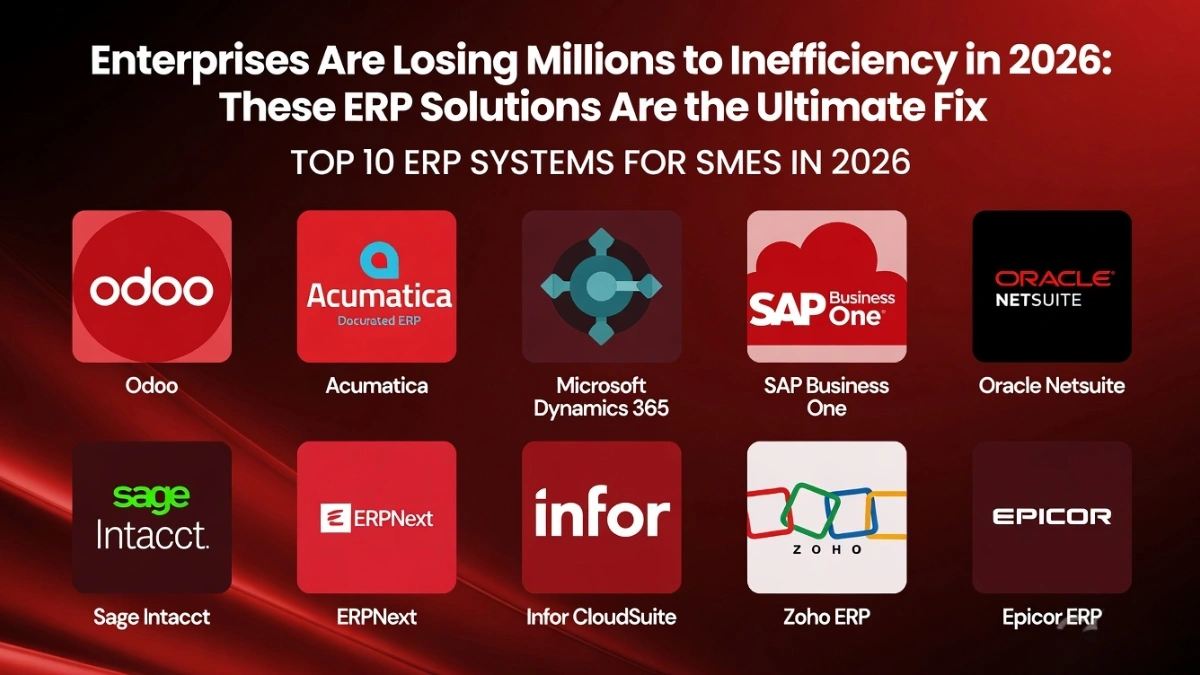
In 2026, large enterprises are operating in an environment where speed, accuracy, and data-driven decisions define success, yet many organizations are still struggling with fragmented systems, manual processes, and lack of real-time visibility, which leads to inefficiencies, rising operational costs, and missed growth opportunities, and this is exactly why ERP software has become the backbone of modern enterprises, as it integrates finance, supply chain, human resources, procurement, and customer operations into one unified system, enabling organizations to streamline workflows, improve collaboration, and scale without chaos, and with the rise of cloud computing, AI-driven analytics, and automation, enterprise ERP solutions are now more powerful than ever, helping businesses transform operations and stay competitive in a rapidly evolving global market.
Why Enterprises Need Advanced ERP Systems in 2026
Enterprises deal with complex operations across multiple departments, locations, and even countries, and managing such complexity without a centralized system creates data silos, inefficiencies, and delays in decision-making, which can significantly impact performance and profitability, while ERP systems solve this problem by providing a single source of truth where all business data is connected and accessible in real time, allowing leaders to make faster and more informed decisions, improve operational efficiency, ensure compliance, and respond quickly to market changes, making ERP not just a tool but a strategic asset for enterprise growth.
Top ERP Software Solutions for Enterprises
SAP ERP
SAP ERP, developed by SAP, remains one of the most dominant ERP solutions for large enterprises due to its deep functionality, scalability, and advanced analytics capabilities, offering modules for finance, supply chain, manufacturing, and more, making it ideal for organizations with complex and global operations that require high levels of customization and control.
Oracle ERP Cloud
Oracle ERP Cloud, powered by Oracle Corporation, is a leading cloud-based ERP solution that focuses on automation, AI-driven insights, and real-time analytics, providing enterprises with tools to manage financials, procurement, and risk efficiently, while its continuous updates ensure that businesses always have access to the latest features without manual upgrades.
Microsoft Dynamics 365
Microsoft Dynamics 365, developed by Microsoft, combines ERP and CRM capabilities into one platform, offering seamless integration with Microsoft tools like Office and Teams, making it a strong choice for enterprises looking for flexibility, user-friendly interfaces, and powerful data insights.
Infor CloudSuite
Infor CloudSuite is known for its industry-specific ERP solutions, providing tailored functionalities for sectors such as manufacturing, healthcare, and retail, allowing enterprises to implement systems that align closely with their operational needs, which improves efficiency and reduces the need for heavy customization.
Workday
Workday focuses on finance and human resource management, offering a modern cloud-based ERP solution with strong analytics and user-friendly design, making it particularly popular among enterprises that prioritize workforce management and financial planning.
IFS Applications
IFS Applications is designed for asset-intensive industries such as construction, aerospace, and energy, providing advanced tools for project management, asset tracking, and service management, which makes it a strong choice for enterprises with complex operational requirements.
ERP Comparison Table for Enterprises
| ERP Software | Best For | Key Strength | Deployment |
|---|---|---|---|
| SAP ERP | Global enterprises | Advanced analytics & scalability | Cloud + On-premise |
| Oracle ERP Cloud | Tech-driven enterprises | AI & automation | Cloud |
| Microsoft Dynamics 365 | Flexible enterprises | Integration & usability | Cloud |
| Infor CloudSuite | Industry-specific needs | Custom solutions | Cloud |
| Workday | HR & finance-focused enterprises | User-friendly & analytics | Cloud |
| IFS Applications | Asset-heavy industries | Project & asset management | Cloud |
Key Benefits of Enterprise ERP Solutions
Enterprise ERP systems provide significant advantages that directly impact business performance, including improved operational efficiency through automation of complex processes, real-time visibility into business performance across departments, enhanced decision-making with data-driven insights, better compliance with regulations, improved collaboration across global teams, and scalability that supports expansion into new markets, making ERP one of the most valuable investments for large organizations.
Challenges Enterprises Should Consider
While ERP systems offer powerful capabilities, implementing them can be complex and resource-intensive, as enterprises may face challenges such as high initial costs, lengthy implementation timelines, data migration issues, and the need for employee training, and selecting the wrong ERP can lead to inefficiencies rather than improvements, which is why careful planning, choosing the right vendor, and working with experienced implementation partners are critical for success.
How to Choose the Right ERP for Enterprises
Selecting the right ERP system requires a strategic approach that considers business size, industry requirements, budget, and long-term goals, as enterprises with complex global operations may benefit from SAP or Oracle, while those looking for flexibility and integration may prefer Microsoft Dynamics, and organizations with industry-specific needs may find Infor or IFS more suitable, and it is essential to evaluate features, scalability, customization options, and vendor support before making a decision, while also testing demos and consulting experts to ensure the system aligns with business objectives.
Conclusion
In 2026, ERP software is a critical component of enterprise success, enabling organizations to streamline operations, reduce costs, and make smarter decisions in a highly competitive environment, and with leading solutions like SAP, Oracle, Microsoft Dynamics, Infor, Workday, and IFS, enterprises have access to powerful tools that can transform their operations, but the key lies in choosing the right system that aligns with their needs and growth strategy, ensuring long-term efficiency and scalability.
Disclaimer: This article is for informational purposes only. ERP selection should be based on detailed business requirements and expert consultation.